What the Walls Already Know: How Touring Artists Learn to Listen Before They Play
Most folks assume the work starts at soundcheck. Load in the gear, run the levels, argue about the monitor mix, grab a lukewarm coffee from whoever's working the door. But ask a road-seasoned Americana artist what they actually do when they first walk into an unfamiliar venue, and you'll get a different answer entirely.
They look around. Slowly. Like they're reading.
Because they are.
The Room as a Living Document
There's a particular kind of intelligence that develops after years of playing every variety of American space imaginable—converted feed stores in the Mississippi Delta, union halls in western Pennsylvania, dance pavilions on the edge of Texas lake country. After enough stages, musicians stop seeing a venue as just a platform and start seeing it as a record. A physical archive of every performance, every crowd, every era that space has absorbed into its bones.
"You walk in and you start reading the room like it's a set of liner notes," says one veteran folk artist who's been touring the southern circuit for nearly two decades. "The ceiling height tells you something. The bar placement tells you something. But it's the stuff people didn't plan—the scuff marks, the old photos, the weird little shrine in the corner—that really talks to you."
This isn't mysticism. It's pattern recognition built from mileage.
Bullet Holes, Boot Scuffs, and the Evidence of a Good Time
The physical details that most first-time visitors overlook are exactly the ones that experienced touring artists zero in on. A pockmarked wooden floor suggests decades of boot dancing—which tells you this crowd moves, which tells you the setlist should breathe a little differently. A pressed-tin ceiling in an old opera house means the acoustics are going to be lively and bright, and maybe the quieter songs will carry more weight than the loud ones.
Then there are the stranger artifacts. A high watermark stained into a brick wall might mean the venue survived a flood and kept going—which says something about the community that supports it. Bullet holes in a barroom door (more common than you'd think in certain corners of rural America) suggest a rougher past and a crowd that probably doesn't need to be coddled. Old murals painted directly onto plaster—depicting local harvest scenes, railroad workers, or Depression-era dances—are practically a briefing document about what the town values and what it remembers.
"I played a Grange hall in central Ohio once that had these incredible hand-painted portraits of local farmers going back to the 1890s," one roots musician recalled. "I opened with a song about land and inheritance, and you could feel the room shift. It wasn't planned. I just looked up before I went on and thought, that's what this place is about."
Handbills, Headshots, and the Genealogy Behind the Bar
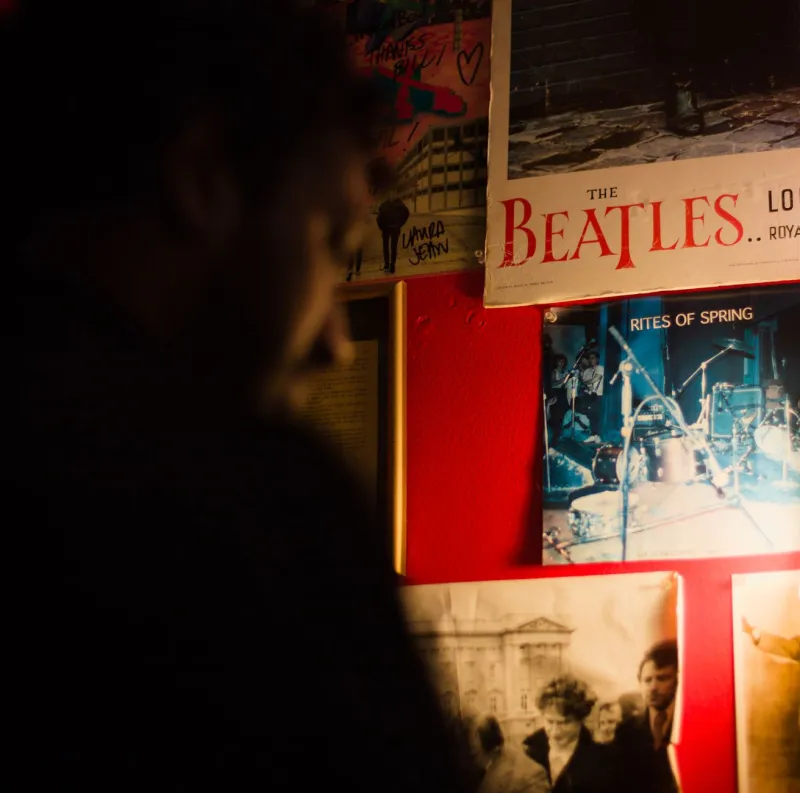
The backstage wall—or the hallway leading to it—is often the richest vein of historical material a touring musician can mine. Venues that have been around long enough tend to accumulate a kind of informal hall of fame: faded concert posters, black-and-white headshots of acts that came through in the sixties and seventies, handwritten set times from shows nobody remembers booking.
Smart artists spend fifteen or twenty minutes back there before they go on. Not just to kill time, but to understand what lineage they're stepping into.
If the walls are covered in country and western acts from the honky-tonk era, you know the room has a certain expectation baked into it—not necessarily a rigid one, but a gravitational pull. If you spot a blues harmonica player's promo card from 1974 next to a punk flyer from 1987 next to a bluegrass festival poster from last summer, that tells you the room is elastic. It can hold contradictions. You can take more chances.
"It's like genealogy," one songwriter put it. "You're tracing your lineage in the room. You want to know whose footsteps you're following in, because it changes how you carry yourself up there."
Architecture as Emotional Context
Beyond the memorabilia, the actual bones of a venue shape the emotional register of a performance in ways that are hard to overstate. A low-ceilinged roadhouse creates intimacy by compression—the sound stays close, the crowd stays close, and the whole thing feels conspiratorial in the best way. A high-vaulted old theater does the opposite: it opens everything up, gives notes room to breathe and linger, and tends to make audiences lean back and listen rather than lean in and holler.
Musicians who've played both know instinctively that the same set doesn't work the same way in both spaces. The architecture is already doing emotional work before anyone strums a chord, and the best performers work with it rather than against it.
Old churches converted into music venues—a surprisingly common phenomenon across the rural South and Midwest—carry their own specific weight. The acoustics alone are extraordinary, built as they were to carry the human voice without amplification. But there's also a residual solemnity that a good performer can use. Crowds in converted churches tend to listen differently. Softer songs hit harder. Silence between verses means more.
When the Room Becomes a Collaborator
The artists who talk most passionately about this practice don't describe it as research, exactly. They describe it as a kind of respect—an acknowledgment that the venue existed before them and will exist after them, and that the performance is really just one more layer being added to everything the space has already absorbed.
That framing changes how you play. It makes you less precious about your own material and more curious about what the room wants to draw out of you. Maybe you dust off a cover you haven't played in three years because a poster on the wall reminded you of it. Maybe you cut a song from the set because it feels wrong for the space—too slick, too polished, too disconnected from the grit embedded in the floorboards.
"The best shows I've ever played," one Americana artist said, "happened in rooms where I felt like I was playing with the history of the place rather than just performing in front of it. You stop being a visitor and start being part of the story."
That's the whole thing, really. The road delivers you to these spaces. But it's the spaces themselves—their scars, their shrines, their stubborn, particular character—that tell you what kind of musician to be once you get there.
And if you know how to read the walls, they'll tell you everything you need to know.